
In the Spirit of Atatice
https://www.youtube.com/results?search_query=In+the+Spirit+of+Atatice
https://www.youtube.com/watch?v=G1K2NQV3WyU
In the Spirit of ʔAtatic̓eʔ: The Untold Story of the National Bison Range. The film chronicled how the Confederated Salish and Kootenai Tribes helped save the bison in the region, and how the National Bison Range — now the Bison Range —came to be under CSKT ownership.
It started with the story of a Pend d’Oreille man named ʔAtatic̓eʔ and his efforts to bring bison to the Flathead Reservation to save them from extinction. The film implored viewers to ponder questions about preservation, land rights, and stewardship.
It was produced by the CSKT and directed by Daniel Glick. It was narrated by ʔAtatic̓eʔ’s great-great grandson Roy Bigcrane. It featured interviews with tribal leaders and key figures in the struggle to bring the Bison Range to CSKT management. The interviews and narration played against the backdrop of beautiful watercolor paintings of ʔAtatic̓eʔ and other figures that were key to bringing the bison to the flathead reservation. The film is available for free on YouTube.
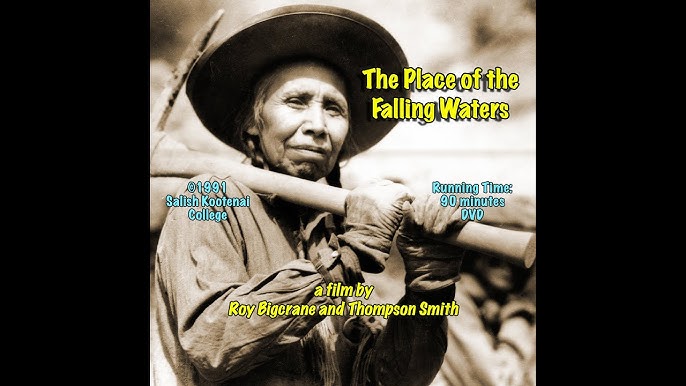
Place of the Falling Waters
The Place of the Falling Waters (Pt 1)
The Place of the Falling Waters (Pt 2)
Place of the Falling Waters by Roy Bigcrane and Thompson Smith.
The dam is described as a sacred location known from the beginning in the Kootenai language as ‘akni ka’nuk — a narrow gap between cliffs — and in the Salish language as stipmétkw — falling waters, according to an essay by Thompson Smith based on the script of The Place of the Falling Waters.
The question posed by Smith and Bigcrane in the documentary persists and may be even more prominent today, three decades later: “Can something that was part of the assault on traditional Native American customs now support the well-being of the tribal community?”
Is Kerr Dam, which caused abrupt and drastic changes to the land and culture, now something that benefits and supports the indigenous community?
Kerr Dam, now named Séliš Ksanka Qíispé Dam, was built in 1938, and after viewing the documentary, it is evident why CSKT people care so much about the dam; their present and future was altered in many ways. It also becomes apparent why Kerr Dam is both a happy and sorrowful site.
Native Americans have always been future-focused and frequently consider the next generation, which is why, when attending a CSKT event on a reservation, one is likely to hear references to “future generations.”
It is about keeping the traditions alive and current, about keeping the water pure, about protecting the land, about revitalizing the tribal language, and it is all for the benefit of today’s tribal people and future generations.
The individuals featured in the documentary, including Mary Small Salmon, Agnes Vanderburg, Joe Eneas, Joe Antiste, Larry Parker, John Peter Paul, Charlie McDonald, and others, are some of those who cared deeply about their heritage, their losses, their fellow Indians, and above all else, the future of tribal people. Francis Auld and Teresa Wall-McDonald are two of the film’s youthful cast.
Agnus Vanderburg had a deep faith in the original people, believing that they would revive the language, practice, and understand their culture, and one can’t help but wonder what she would say today and if she would be proud.
Since the movie was released in 1990, many of the known faces are still alive and some are no longer with us.
Before the documentary began, an audience member stated that she has seen the film several times and enjoys viewing it to see old images, video, and faces of folks who are no longer part of the CSKT community. Consequently, the documentary is now even more unique.
Bigcrane estimated that it took six years to produce the documentary; he and his close buddy Smith came up with the idea in the early 1980s. It was a big affair, and Bigcrane thought it was great because it allowed them to interview elders who could speak from the past.
The documentary and unedited interviews are available on the SKC YouTube site. Bigcrane has been working on making such things available to the public; he wanted those films and unedited interviews to be available to the public since the information is valuable and culturally educational.
Adeline Mathias & Alec Lefthand Interview #1
https://www.youtube.com/watch?v=irGoqmmtRao
Joe Phillips The Place of the Falling Waters interview 1988
https://www.youtube.com/watch?v=dF8z5e0JudA
Char-Koosta News